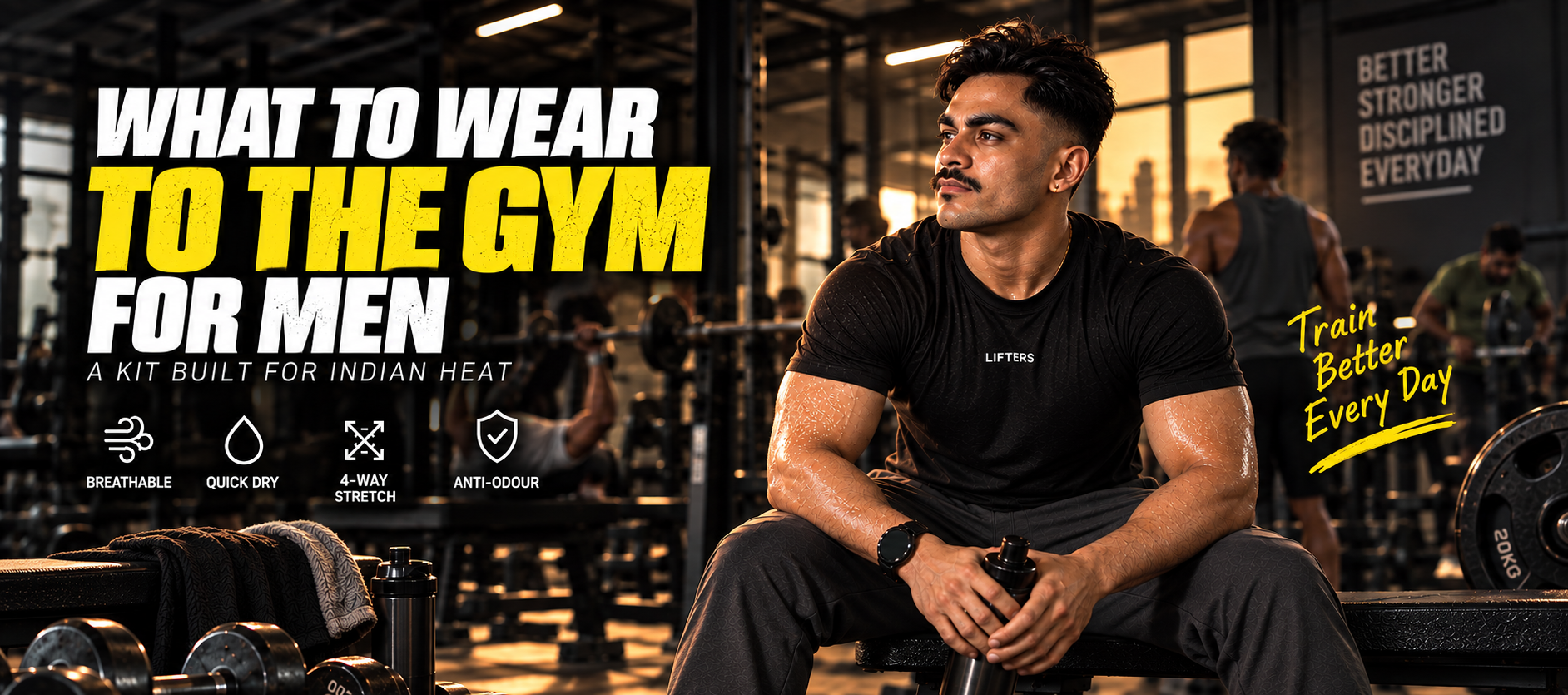
What to Wear to the Gym for Men: A Kit Built for Indian Heat
It is 7:10pm in a Delhi gym. Four people are queued for the bench. Your cotton tee stopped absorbing anything twenty minutes ago and is now a wet sheet stuck to your back. You still have three working sets and a forty minute ride home. What to wear to the gym is not really a style question in this country. It is a logistics question. What to wear to the gym comes down to two questions
Every gym outfit for men comes down to this:
Answer those honestly and the rest is preference. Answer them badly and you own a drawer full of clothes you train in once and then avoid. The top: pick by how long the session actually runs
Four options, and each one wins in a different situation. The loose cotton tee
Fine for a forty minute December session. By set four in May it holds sweat instead of moving it, gets heavy, and clings in the exact places you do not want it clinging. Most men own too many of these. Read how many gym t-shirts you actually need before you buy another one. The fitted performance tee
Quick-dry fabric, stays put under a bar, does not ride up when you go overhead. This is the default for most people training four or more days a week. The Premium Tech T-shirt sits here: slim fit, four-way stretch, matte finish, quick-dry, listed at ₹1,099 at the time of writing. Compression
Not magic. It is a sweat management and fit decision, and it is a different feel that some people never get used to. We have argued both sides already in compression t-shirt vs regular gym t-shirt . Short version: compression moves sweat off the skin well and sits flat under a bar, a loose tee breathes better and lets you forget you are wearing anything. The vest
Best airflow of the four. Worst coverage on a shared bench, and some gyms still have a rule against it. Know your gym before you commit a drawer to them. Decision rule: if your session runs past 45 minutes between March and October, stop training in cotton. That is the whole rule. The bottom half, where most men get it wrong
Almost every "what to wear in gym" list spends 80% of its words on the top and then says "and comfortable bottoms". The bottom half is where the actual trade-offs are. Shorts
The obvious answer for most of the Indian training year. Three catches: shared benches, chafing on high-volume leg days, and the way loose shorts ride when you squat deep. Length matters more than fabric here. Mid-thigh sits still, very short rides, very long flaps against the pad. Joggers
The tapered ankle earns its keep. It stops fabric catching on a leg press sled and it keeps the hem off the floor of a gym where the floor is not always clean. The current cut is looser through the thigh with the taper kept at the bottom, which is what the Lifting Club Loose Joggers are: loose fit, 80% cotton and 20% polyester, 350 GSM, treated with an anti-odour and anti-bacterial wash, listed at ₹1,199. Here is the honest part. 350 GSM with cotton as the majority fibre is a heavy, warm fabric. It is excellent from November to February, excellent as a commute-and-rest-day bottom, and genuinely wrong for a July session in Chennai. Buy them for the months they suit. Do not pretend they are a summer training pant. Wide sweatpants
Style-led, and there is nothing wrong with that as long as you know it. A wide, high-rise, straight cut looks good and moves fine, but it is more volume of fabric than a hot room needs. The Lifting Club Wide Sweatpants are the same 350 GSM cotton-poly build as the joggers, so the same seasonal logic applies. Lightweight performance pants
The answer when you want a covered leg without the weight. The Versatility Pants are built for this: athletic fit, four-way stretch, abrasion-resistant, moisture-wicking and quick-drying, listed at ₹1,699. They cost more than the joggers and they do a narrower job. That is the trade. March to October is a different sport
India's training year is not one season. The India Meteorological Department records heat and humidity across most of the country from March through October that make the second half of that year functionally a different climate to plan clothes for. The mechanism worth understanding: sweat cools you by evaporating. In high humidity it evaporates slowly, so it pools in fabric instead. Guidance from bodies like the American College of Sports Medicine on exercising in heat is worth reading if you train hard through an Indian summer. From a clothing point of view the practical consequence is simple. The fabric's job in a humid gym is to move sweat away from your skin and dry fast, not to soak it up. What that means in practice: The things nobody puts in a gym-outfit list
Where Lifters fits, and where it does not
We make around ten pieces, mostly black and grey, S to XL. We do not make shoes, socks, women's kit or plus sizes, and we are not going to pretend a range exists that does not. What we do make is the tops layer and, now, three bottoms. If you are building a kit from scratch, the tops are where we would put your money first, because that is the layer that fails soonest in an Indian summer. The bottoms are worth adding once you know which months you train hardest in. You can see all three on the bottoms page . The rule to walk away with
Buy for the month you dread, not the month you like. Most men buy gym clothes in a cool week in December and then train in them through June. Pick the single worst session of your year, the hottest room and the longest workout, and buy the kit that survives it. Everything else in the calendar is easier by comparison.
-
October 26th, 2026
-
What to Wear for Home Workouts: Gym Clothes That Work in Your Living Room
October 23rd, 2026