Compression T-Shirt vs Regular Gym T-Shirt: Which One Should You Actually Train In?
Walk into any serious gym in India and you'll see the split immediately. One half of the floor is in tight, second-skin compression tops. The other half is in loose cotton or a relaxed-fit training tee. Both groups are lifting well. Both are convinced they've got it right. So which one actually belongs in your gym bag? The honest answer is that they do different jobs, and most lifters who train more than three days a week end up owning both. But knowing which one to reach for on a given day is the difference between a session where your kit disappears and a session where you're pulling a soaked shirt off your back between sets. Here's what actually separates them.
What a compression t-shirt is really doing
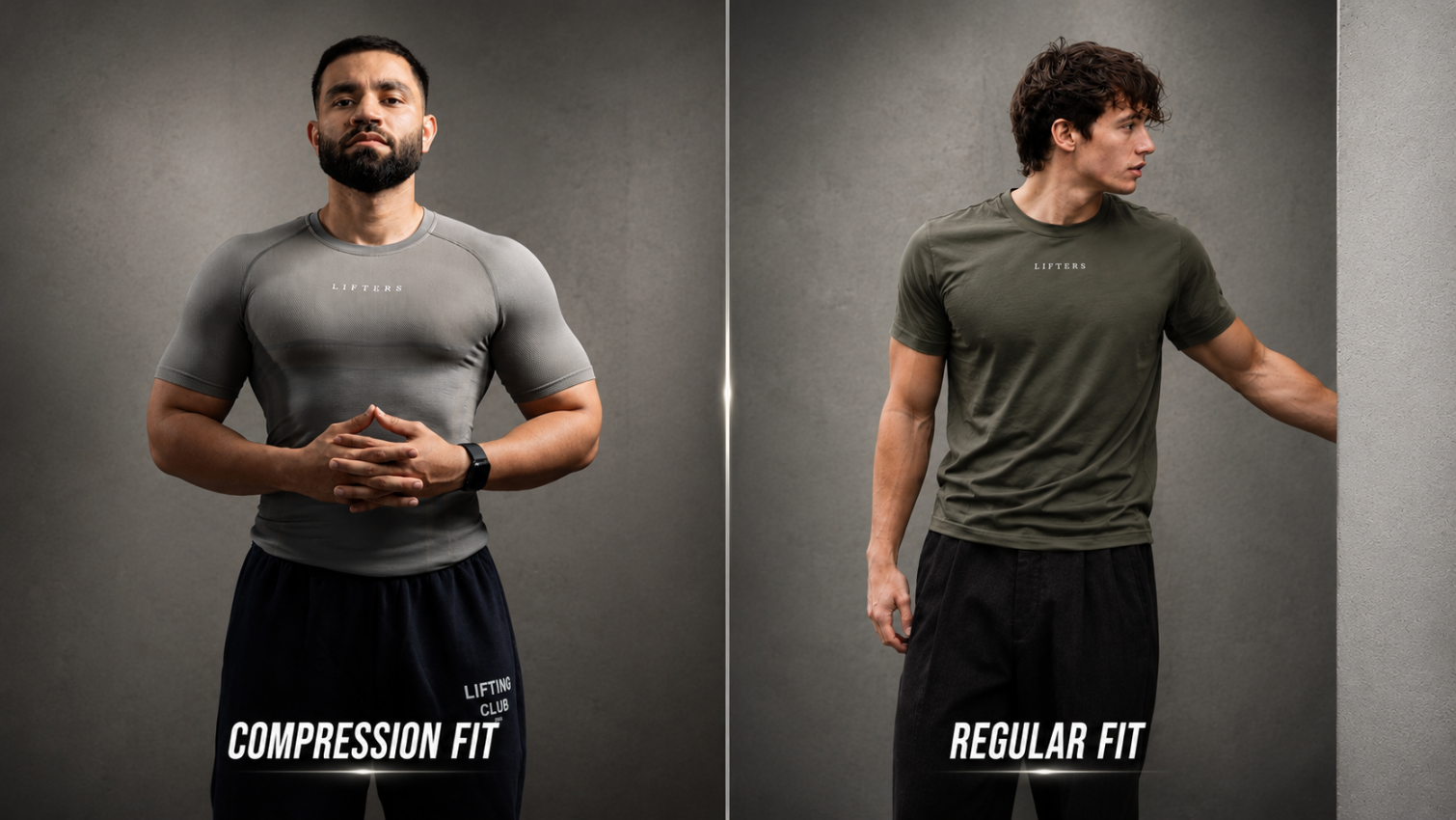
Compression wear is built from high-stretch knit fabric — usually a nylon or polyester blend with a high elastane content — engineered to apply gentle, consistent pressure across the muscle. It isn't just a tight t-shirt. A tight cotton tee stretches out, sags, and stops pressing. A proper compression top holds its pressure through the whole session and returns to shape after every wash. That pressure does three things worth caring about: It reduces muscle oscillation. Every time you press, pull, or run, your muscle tissue vibrates on impact. Compression damps that movement. Less vibration over a long session means less micro-fatigue accumulating in the working muscle. It supports circulation and recovery. This is where the research is strongest. Studies on compression garments consistently point to reduced delayed-onset muscle soreness and faster perceived recovery in the 24–48 hours after hard training. The evidence that compression makes you stronger mid-set is much weaker — anyone telling you a shirt adds kilos to your bench is selling you something. But the recovery benefit is real and it's the reason so many athletes wear compression after training, not just during. It improves body awareness. The technical term is proprioception. Fabric in constant contact with skin gives your nervous system more feedback about where a limb is in space. In practice, lifters describe it as feeling "locked in" — more aware of scapular position on a row, more aware of elbow path on a press. There's a fourth benefit nobody puts on a spec sheet: compression wear shows you your own movement. When the fabric sits flush against your back, you can see whether your lats are actually engaged in a mirror. A loose tee hides all of that.
What a regular gym t-shirt does well
Regular training tees get unfairly dismissed, and they shouldn't be. A well-made technical tee gives you unrestricted range of motion. Nothing pulls at the shoulder on an overhead press. Nothing tugs across the chest at the bottom of a bench. For the biggest, heaviest compound lifts, some lifters genuinely move better with fabric that isn't gripping them. It also gives you airflow. A looser cut lets air move across your skin, which matters enormously if you're training in a non-air-conditioned gym in Pune in May, or doing conditioning work outdoors. Compression traps a thin layer of warm air against the body — great in a cold gym in December, less great at 34°C and 70% humidity. And a good training tee is socially versatile. You can wear it to the gym, wear it home, wear it to get coffee. A compression top is a more deliberate statement. The catch: this only applies to a technical tee. A ₹399 cotton round-neck is not a gym t-shirt. Cotton absorbs sweat and holds it — the shirt gets heavy, cold, and starts chafing at the underarms and nipples within twenty minutes. Most people who think they hate gym t-shirts actually just hate wet cotton.
Head to head, on the things that matter
Sweat management. Both a compression top and a technical tee will wick — that's a fabric property, not a fit property. But compression wicks faster because it's in full contact with skin, pulling moisture off the body the instant it appears. A loose tee only wicks where it touches you. In a heavy session, compression wins here clearly. Chafing. Compression wins, provided it's seamless. Traditional stitched compression can rub at the shoulder and side seams under repeated movement. Seamless construction removes those pressure points entirely, which is why seamless has become the default in serious training wear. Freedom of movement. A close call, and it depends on quality. Cheap compression restricts. Good compression — with proper four-way stretch — moves with you and you forget it's there. But at maximal loads on squats and deadlifts, where you want to brace hard and expand your midsection, some lifters still prefer the loose tee. Trust what your body tells you here. Heat. Loose tee wins in genuine heat. Compression wins in cold gyms and early-morning sessions. Recovery. Compression, comfortably. If you're training six days a week and soreness is limiting your next session, this is a real advantage. Durability. Compression, if you buy well. A quality compression top holds shape for years. A cotton tee stretches at the collar within months.
When to reach for compression
- Push, pull and accessory days — anything where you're chasing muscle contraction and want feedback on form
- High-volume hypertrophy work — the sessions that leave you sore
- Cold or early-morning training — compression keeps muscles warm through your warm-up sets
- Back-to-back training days — wear it for the session and keep it on for an hour after
- Conditioning, HIIT and functional work — where a loose shirt just flaps and gets in the way
- Under a hoodie or oversized tee — the most common way people actually wear it in Indian gyms
A long-sleeve compression top like the Core Compression Long Sleeves T-shirt covers the full arm, which matters if you're doing anything where forearms contact equipment. If you want the same coverage without any seam contact at all, the Stealth Seamless Compression Long Sleeve T-shirt is the version built specifically to eliminate that.
When a regular tee is the better call
- Max-effort squat and deadlift days, if you find compression restricts your bracing
- Outdoor training in peak Indian summer — midday runs, sled work, anything under direct sun
- Non-AC gyms in May and June — airflow beats wicking when the ambient temperature is high enough
- When you're not feeling it — some days you want to train without being reminded of exactly what your body looks like. That's a legitimate reason and nobody should pretend otherwise.
- Long sessions where you'll be around people afterwards
For these, a fitted-but-not-tight technical tee is the sweet spot — something like the Premium Tech T-shirt or, if you want a seamless build with a looser drape, the Hybrid Seamless T-shirt. In serious heat, a Flex Seamless Vest beats both.
What to check before you buy either one
For compression:
- Elastane content of at least 10–15%. Below that, it's a tight shirt, not a compression garment.
- Seamless or flatlock construction. Standard overlock seams will rub.
- Stretch recovery — does it snap back, or does it stay stretched? Cheap compression goes baggy after ten washes and then it's doing nothing at all.
- Length. It should stay tucked when you go overhead. A top that rides up mid-set is a distraction you'll notice every rep.
For a training tee:
- No cotton, or a very low cotton blend
- Reinforced or seamless underarm construction
- Enough length in the torso to stay put on overhead work
- A colour that doesn't broadcast sweat patches, if that bothers you — mid-tones and prints hide it, light grey is the worst offender
Getting the fit right
This is where most people go wrong with compression, so it's worth being direct. Compression should feel snug the moment you put it on — noticeably tighter than a normal shirt, but never restrictive. You should be able to take a full deep breath without effort and get your arms overhead without the hem lifting off your waist. If you feel pressure on your chest at rest, it's too small. Do not size up because you're self-conscious. A compression top that's a size too big provides no compression, wicks worse, and — because it bunches — actually looks less flattering than the correct size. Size to your chest measurement, not to how you feel about your midsection. Also worth knowing: compression feels tightest on the first wear and settles into a comfortable snug fit after two or three sessions. Give it that window before you judge it.
The verdict
Compression t-shirts are the better tool for most of your training week — better sweat handling, less chafing, meaningful recovery benefit, and more feedback on how you're moving. Regular technical tees are better for maximal lifting, genuine heat, and the days you want your kit to be invisible. If you're buying one, buy compression. If you're building a kit, own two or three compression tops and two good technical tees, and stop thinking about it. The real upgrade for most people isn't compression over regular. It's getting cotton out of the gym bag entirely.
FAQ
Does compression wear make you lift heavier?
No. Any brand claiming a shirt adds weight to your lifts is overselling. The measurable benefits are in recovery, soreness reduction, sweat management and movement feedback — not in raw strength output on the day. Can you wear compression t-shirts all day?
Yes, comfortably. Compression garments are worn for extended periods in athletic and clinical settings. Many lifters keep theirs on for an hour or two post-workout specifically for the recovery benefit. Is compression wear good for beginners?
Yes — arguably more useful for beginners than advanced lifters, because the extra body awareness helps with learning movement patterns. The only real barrier is comfort with the fit, which most people get used to within a couple of sessions. How tight should a compression t-shirt be?
Snug against the entire torso, with no pinching at the chest or shoulders, and full range of motion overhead without the hem riding up. Tight enough that you feel it, loose enough that you forget it after ten minutes. Compression or regular t-shirt for cardio?
Compression for indoor cardio and HIIT. A loose technical tee or vest for outdoor running in Indian summer conditions, where airflow matters more than wicking speed.
-
October 26th, 2026
-
What to Wear for Home Workouts: Gym Clothes That Work in Your Living Room
October 23rd, 2026